

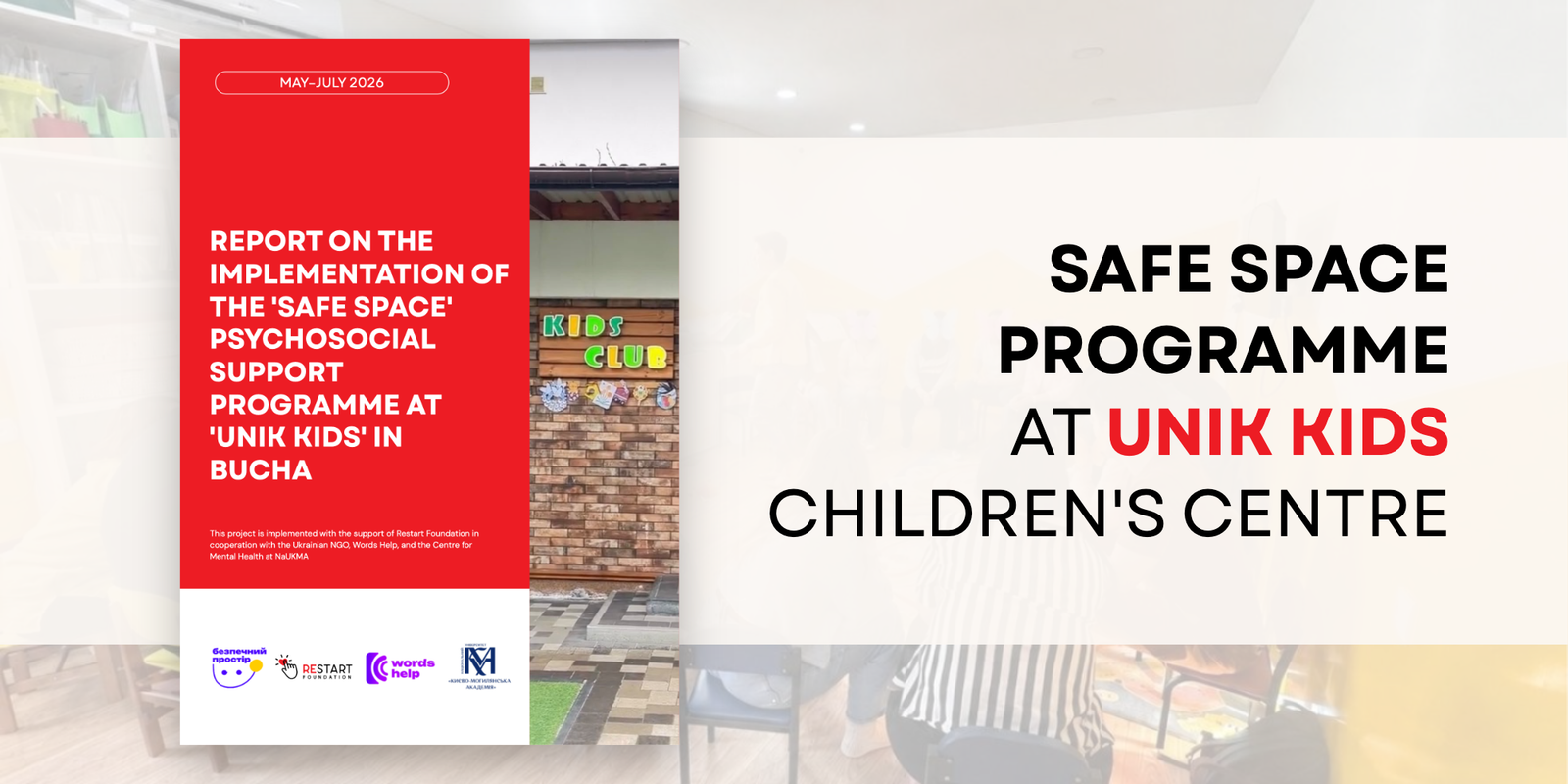
Report · May–July 2026
This report presents the results of the Safe Space programme at the ‘UNIK KIDS’ full-day children’s development centre in Bucha — a community still living with the consequences of the 2022 occupation.
Implemented with the support of Restart Foundation, in partnership with the Ukrainian NGO Words Help and the Mental Health Centre at the National University of Kyiv-Mohyla Academy (NaUKMA).
Delivered by the project team: Oksana Zaleska (supervisor), Oksana Tunik (mentor) and trainees Svitlana Kulbabenko, Oleksandra Mangusheva and Yulia Yarchevska — the centre’s own director.
The Context
Growing up in Bucha
The children in this programme are growing up in a town that survived the 2022 occupation, in which 381 people were killed. In some families a parent is now at the front; some of the children were born during the war and have known no other childhood. After de-occupation, the kindergarten had to rebuild part of its premises to fit a deep shelter where children can be hidden during shelling.
That constant underlying tension shows in the children’s behaviour — heightened aggression, difficulty with self-regulation, hyperactivity and anxiety — and the project period coincided with intensified ‘Shahed’ drone attacks, with up to 500 launched in a single night. Against that backdrop, the programme ran in an intensive format, twice a week.
About the Programme
A safe space, twice a week
The Safe Space programme was developed by the Mental Health Centre at NaUKMA to strengthen children’s resilience and support their emotional wellbeing in wartime. From May to July 2026, three therapeutic groups of 21 children took part at UNIK KIDS, through play, creative exercises, movement, sensory materials and work on emotions.
The centre came to the programme through its own director, Yulia Yarchevska, who had interned on the Safe Space project at the Mriy-Diy kindergarten in 2025 and set out to recreate it for her own children. She joined this programme as a trainee — mentored and supervised, yet leading her group from the very first session — and earns her trainer certification at the end of the placement.
Who received support
people
There were three trainees in all: two taking part alongside the centre’s director, who trained as a psychologist while leading her own group. Total: 53 unique participants.
How the 76 activities divided
activities
| Activity | Number |
|---|---|
| Work with children & parents | |
| Individual meetings with parents | 16 |
| Group sessions with children | 10 |
| Observations | 6 |
| Group meetings with parents | 5 |
| Referrals of children for specialised support | 5 |
| Referrals of parents for specialised support | 2 |
| Professional support | |
| Supervision sessions for trainees | 12 |
| Mentor discussions | 10 |
| Resource & methodology meetings with educators | 4 |
| Certification of trainees recommended to deliver under supervision | 2 |
| Supervision sessions for mentors | 2 |
| Supervisory & organisational meetings with management | 1 |
| Certification of a trainee as a programme trainer | 1 |
| Total activities | 76 |
Key Findings
What changed over the programme
Children
Across all three groups, the children found support and safe ways to express and process their emotions. Over the six weeks their resilience grew and their anxiety eased, even as the war kept surfacing in their play and drawings.
Parents
Twenty-six parents gained a support network and new tools — learning to see the hidden need behind a child’s difficult behaviour, and understanding more about how a child’s mind works and what helps.
Teachers
Educators learned about professional burnout and how to protect their own resilience, alongside healthier ways to respond to conflict and challenging behaviour — direct work with a child’s emotions in place of familiar threats.
Professional capacity
Three trainees built experience holding group dynamics and their own reactions under supervision. The centre’s director led her group from the first session and completes her certification as a Safe Space trainer.
“Both Dana and I were left with nothing but positive impressions. The atmosphere was incredibly warm and comfortable. Thank you for such a wonderful and useful initiative — for children and for parents alike.”
Natalia Prysyazhnyuk, Dana’s mum
In Conclusion
Behaviour as a language
Over a month and a half, the programme moved from a tentative introduction to deep, trusting work across all three children’s groups, their parents, the teachers and the trainees. The most important systemic insight: in a community still living beside the war, a child’s ‘difficult behaviour’ is almost always the language of the body where words are not yet available.
The programme showed that, even in a short window, those dynamics can shift — resilience can grow and anxiety can fall — as long as the work happens at once with the child, the adults closest to them, and the support system around them both.
Read the full report
Available in English and Ukrainian (PDF)
