

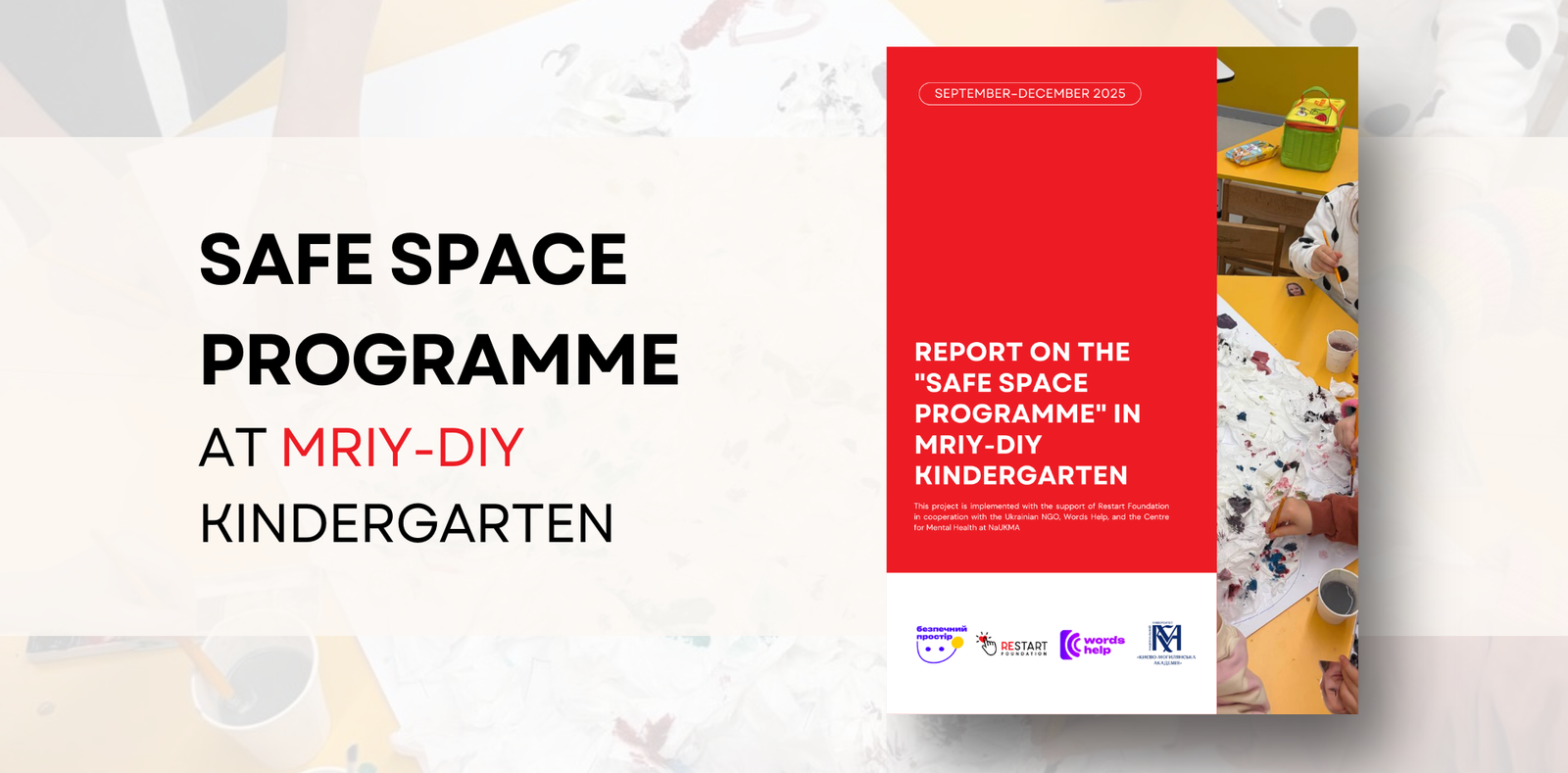
This report was prepared as part of the implementation of the ‘Safe Space’ psychosocial support programme for pre-school children, which was carried out at the kindergarten MriyDiy in Kyiv from September to December 2025. The initiative was implemented with the support of the Restart Foundation in partnership with the NGO ‘Words Help’ and the NaUKMA Mental Health Centre.
The report covers the experiences of all parties involved: parents, nursery staff, management, and the specialists who directly delivered the sessions. Particular emphasis is placed on reflecting on the challenges encountered and the recommendations developed as a result. The report was prepared by the project team: Oksana Zaleska (supervisor), Alla Yansons (CEO of Restart Foundation), and Yevheniia Zavorotynska (project mentor).
participants total
children in 3 groups
parents engaged
weeks of sessions
Context: autumn 2025 in Kyiv
Each of our reports begins with a description of the context in which the programme was implemented. Ukrainians try to maintain the natural rhythms of their lives — going to work, raising children, studying, playing, rejoicing and loving. At the same time, they must be able to run quickly to shelter, get used to sleep deprivation, and overcome their fear every day during heavy shelling. This is the backdrop against which adults live, trying to create conditions so that the children growing up alongside them feel its impact less.
During the project’s implementation, the team faced not only constant shelling but also an energy crisis, blackouts, a lack of heating, and communication disruptions. The nursery became a place where, thanks to extraordinary efforts — back-up power supplies, generators, alternative heating — there was warmth and light. There were also several hits on residential buildings near the nursery. On the night of 23 October, enemy drones attacked the Podilskyi district, with 32 casualties reported across the city.
Children experience and witness the war first-hand. They are alert to dangers, but often adapt to their parents’ beliefs and hide behind bad behaviour, psychosomatic symptoms, or withdrawal. All 21 children who participated in the programme had experienced anxiety, taking shelter, and the sounds of shelling and explosions. Four were internally displaced persons; five were family members of military personnel.
About the programme
Three children’s groups of 7–8 children each were formed at MriyDiy. Sessions were held weekly over 10 weeks in a therapeutic group format: psychological guidance, play activities, creative exercises, physical movement games and work on emotions using metaphors. A team of four specialists delivered the programme:
Supervisor
Oksana Zaleska
Mentor
Yevheniia Zavorotynska
Trainee — nursery psychologist
Iraida Mukhina
Trainee — psychology master’s student
Yulia Yartchevska
Group work with children
Throughout the cycle of sessions, a positive trend was observed across all three groups. At the start, the children approached the process with wariness, testing the rules and boundaries, and struggling to maintain a shared framework. Subsequently, they gradually became better at staying in the circle, remembered the rules, remained in the shared process for longer, and began to express their feelings not only through behaviour but also through drawing, play, stories and discussions of emotions.
Group 1
Shifted from pronounced chaos and overexcitement to partial stabilisation through shared play and the gradual acceptance of boundaries. Towards the end of the cycle, themes of abandonment and the need for parental presence became particularly pronounced.
Group 2
The most balanced and structured in terms of dynamics. Children’s ability to name their own experiences and talk about their fears — particularly regarding darkness, danger, the unknown, and wartime — had noticeably increased by the middle of the cycle.
Group 3
Progressed from initial interest and good rapport to a deeper exploration of themes such as impulsivity, loss, hurt feelings and separation anxiety. By the end of the cycle the group had become calmer; feelings were increasingly expressed through stories, play, cards, shared games and requests for support.
Despite the groups’ differing starting points, by the end of the cycle all of them showed an improvement in their ability to connect with others, participate in shared activities, follow rules more effectively, discuss difficult experiences, and rely on adults and the group as sources of support. Parents also noted positive changes outside the sessions: reduced tension, improved sleep, and greater openness towards contact and emotions.
Working with parents
An analysis of parents’ responses shows that the war remains a constant backdrop to family life. Most often, parents describe their children’s fear of loud noises, anxiety before bedtime, and worries about their home and loved ones. Children say: “I’m scared,” “Are we definitely going to win?”, “Will a rocket hit our house?”, “When will this end?”
Parents try to maintain stability and not exacerbate their child’s anxiety, often at the cost of their own difficult experiences: restless sleep, lack of sleep, and overwhelming fear — not for themselves, but for their children. Three joint meetings and ten individual feedback sessions were held with families across the programme.
“After the programme, my son stopped repeating words about war, the enemy, drones and so on. He has become calmer, sleeps better, and is better at managing his emotions. Our relationship with him has become warmer and more open. I realised that it is important to share your feelings in order to feel safe.”
Veronika Kolodyuk, parent
Challenges and learning
This report is notable for its honest reflection on the difficulties encountered — as much as on the successes. The team faced a lack of dedicated administrative support at the institution, limited direct contact with parents (all communication was relayed through management), and tension with some teachers who disagreed with the programme’s less directive, child-led approach.
The institution was clearly oriented towards an educational-academic model, with very limited space for free play — a fundamental component of Safe Space’s approach to children’s emotional development. Despite this, thanks to the team’s efforts, supervisory support, and flexible adaptation, the work with the children was carried out to a sufficiently high standard.
Teacher feedback
Zoryana Mykhailova, despite limited involvement, observed positive change: “The children have become more confident and have also started to trust one another more. I believe that I will be able to incorporate elements of Safe Space into my sessions with the children on my own.”
Trainee feedback
Yulia Yartchevska described the experience as professionally meaningful: “The programme is a space that teaches not only the child but also the adult — to be attentive to emotions, to better understand one’s own state, and to become a support and guide for the child.”
Conclusions & recommendations
The implementation of the Safe Space programme at MriyDiy confirmed that systematic psychosocial support for pre-school children in wartime is relevant, in demand, and capable of delivering tangible results even within a complex organisational context. The project can be assessed as substantively effective for children, beneficial for some parents, and professionally meaningful for trainees.
The experience also demonstrated the need for clearer procedures for launching the programme and selecting partner institutions. As a result, the team has strengthened its preparatory process for future roll-outs: a project launch algorithm has been developed, trainee preparation has been deepened, and kindergarten selection criteria now include an assessment of value-based alignment with the Safe Space philosophy — particularly regarding respect for children’s agency and the importance of free play.
19 supervision sessions were held during the reporting period, supporting the specialists throughout implementation and enabling the team to adapt flexibly to the institution’s conditions. The nursery’s psychologist, Iraida Mukhina, continues to receive weekly supervision as part of the project.
Read the full MriyDiy programme report
Detailed findings, group dynamics, parent and trainee feedback — available as a PDF.
Want to bring Safe Space to your kindergarten?
Learn about the programme, registration, and how to get involved.
