

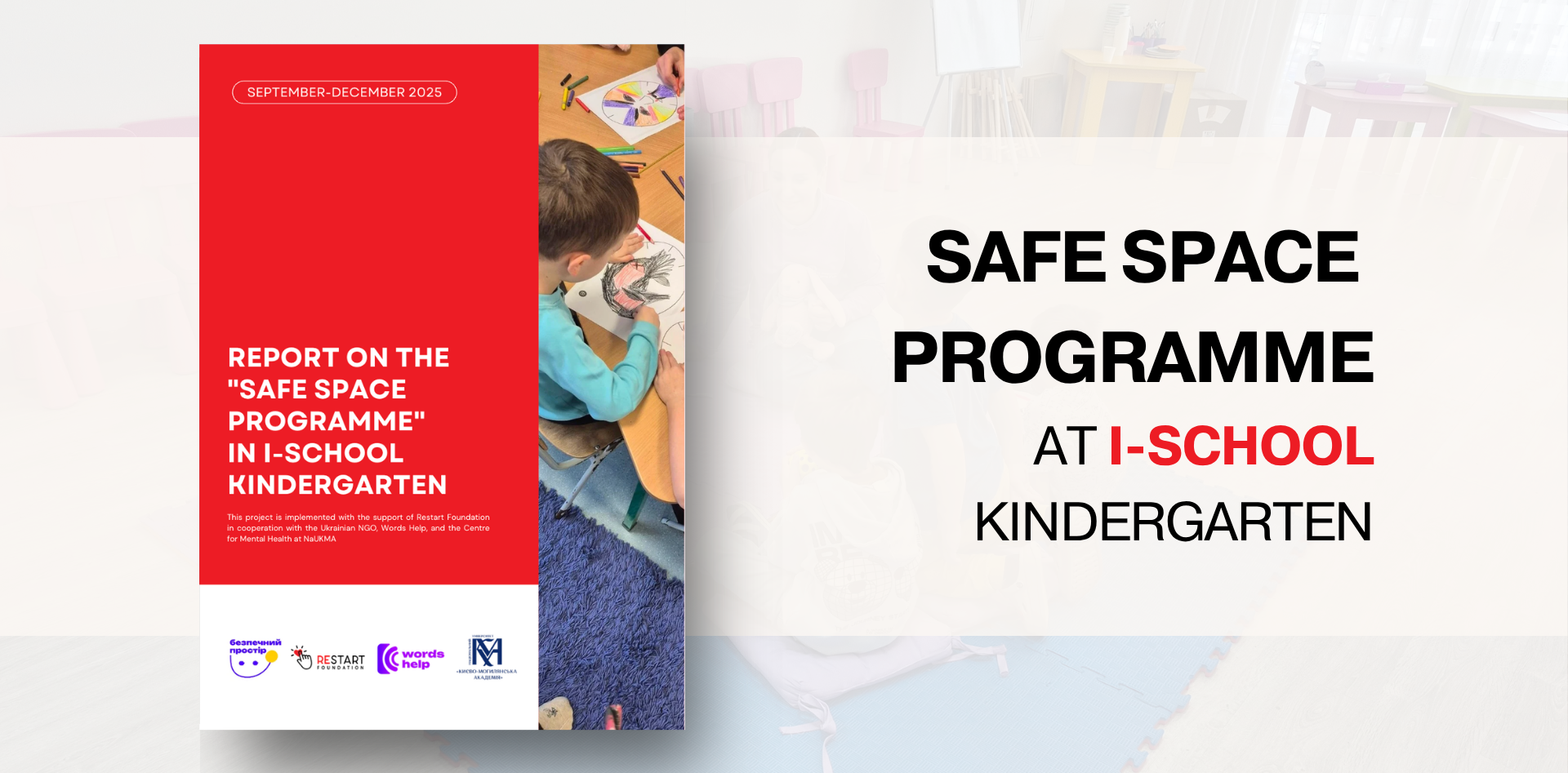
Between September and December 2025, Restart Foundation’s Safe Space programme was implemented at the I-School kindergarten in Kyiv — an institution operating an intensive academic curriculum. This report documents what happened over those twelve weeks: the challenges, the breakthroughs, and the evidence of real change in children, educators, and families living through the fourth year of war.
The Context
Every report begins with the same backdrop
Each of our programme reports opens with a reminder of what life looks like in Kyiv right now. Adults going to work, raising children, trying to maintain ordinary rhythms — while simultaneously being ready to run to a shelter at any moment, managing chronic sleep deprivation, and overcoming fear during mass attacks. This is the context in which the Safe Space programme was delivered.
During the implementation period, several strikes hit residential buildings in the immediate vicinity of the I-School kindergarten. After nights of heavy shelling, children arrived to their sessions either overexcited or visibly exhausted. The war was not an abstract backdrop — it entered the room directly, in the children’s behaviour, their drawings, their questions, and their fears.
“Children feel and see the war with their own eyes. They often adapt to their parents’ beliefs and hide their anxieties behind difficult behaviour, psychosomatic symptoms, or withdrawal.”
From the Programme Report, Restart Foundation
preschool children participated
weekly sessions delivered
parents engaged
educators supported
The Challenge
A kindergarten with its own strong culture — and its own resistance
I-School operates according to innovative intellectual programmes, preparing children for intensive academic learning from a young age. From the outset, educators and psychologists at the institution reported difficulties managing children’s behaviour, maintaining group discipline, and dealing with children who frequently refused to engage with tasks. The administration also flagged significant staff exhaustion.
When the Safe Space team introduced the programme — with its philosophy of playfulness, emotional safety, and relational learning — they encountered genuine resistance. The institution’s existing culture leant towards an authoritarian style of interaction with children. Educators were uncertain whether the programme could work in their setting, and some were sceptical of the psychological and organisational changes it would require.
That initial resistance proved to be one of the most important elements of the story. Over twelve weeks, it transformed into something else entirely.
“The difficult work transformed into fruitful and productive cooperation. At the end of the project, we are pleased with the results and have well-founded hope that the changes that occurred in the kindergarten will make it possible to build a truly safe space for children to grow.”
Programme Team, Restart Foundation
Working with Educators
Adults first — ten sessions of support and reflection
Between October and December 2025, mentor Olena Tkachenko held ten supervisory and support sessions with the educators’ team — each lasting approximately one hour. The core group consisted of four teachers and the institution’s psychologist, with the director and methodologist joining on separate occasions.
Support was structured around two interconnected themes: professional development (the Safe Space methodology, recognising stress responses in children, the role of play, attachment theory) and burnout prevention (normalising exhaustion, restoring the team’s sense of internal resource, and rebuilding trust within the group).
At the first session, it was already apparent that the team was carrying a significant load. Rather than adding another professional demand, the approach was deliberately gentle — beginning with a shared exercise on sources of personal support, later watching and discussing a film together, and only gradually introducing more directly professional content. The session on attachment theory, centred on the documentary John by James Robertson, proved a turning point: educators began to see their daily role with children in a new light.
“First of all, the sessions showed me how to support children’s behaviour in certain situations and how to address anxiety. We began devoting more time to play, combining it with learning and using Safe Space exercises. The children became more open, sincere, friendly, and better adapted.”
Educator, I-School kindergarten
“The Safe Space group sessions helped strengthen the trusting relationship between the children and me. The children became more open, their desire to spend time together increased, the number of conflicts decreased, and interactions became calmer and warmer.”
Educator, I-School kindergarten
Working with Children
Three groups. Eleven weeks. One shared trajectory.
Twenty-three preschool children were divided into three groups of seven to eight. Sessions ran weekly for eleven weeks in a therapeutic group format combining psychological information, play activities, creative exercises, physical movement, and work with emotions through metaphor and imagery.
All three groups shared a common arc: from an initial phase of scanning and testing the new adults, high energy and the need for clear limits, to growing composure, the enjoyment of ritual and structure, and an emerging ability to express internal states through play and creativity. Sessions held after nights of heavy shelling were noticeably different — children arrived either overexcited or depleted, and the session structure itself (movement, music, the candle ritual, the closing circle) performed the most important stabilising function.
The most effective tools across all three groups were consistency and sensory-physical elements: bubble activities, creative tasks with calm music, the candle as a transition to quiet, and closing rituals — hugs, high fives, a gentle tickle — that gave children a predictable ending and the experience of safe physical contact.
What the children showed us
Children symbolised fear through drawings and imaginative play before they could name it in words. Anger was safely discharged through tearing paper and making snowballs. The word “secret” brought a whole room to silence and attention. One child said, at the close of the programme, that she was “no longer afraid to stay in the nursery.” A teacher described another child as “completely unrecognisable” after the programme, due to the improvement in their behaviour and emotional regulation.
Working with Parents
From spectators to partners
Three joint meetings and ten individual family feedback sessions were held with parents over the course of the programme. Initial wariness — about the war as a topic, about new psychologists, about whether the programme was evidence-based — gradually gave way to trust and engagement.
The final session, held jointly with the children and attended by both mothers and fathers, was described by parents as a first: for the first time, they felt not like observers at a school event, but as genuine partners in their child’s process. Parents reported children beginning to name and describe their emotions, asking for particular calming rituals at home — rocking in a blanket, candlelight, a favourite evening routine — and showing greater openness to sharing their feelings.
“He became calmer and more attentive to his emotions. He began to talk more often about what he is feeling and to name his emotions. He better understands that emotions are normal and can be safely managed. What was especially valuable was that everything happened through play, creativity, movement, and warm communication.”
Ms Natalia, mother of Jamal
“I would like to separately mention the psychologist’s meetings with parents and the joint session in the ‘child–parent–psychologist’ format — it was profound and useful for the whole family.”
Victoria Fisonova, Sofia’s mother
Referrals
Four children referred for specialist support
As a result of the programme, four children were referred for further specialised psychological assistance. Indicators identified during group sessions went beyond what short-term group support could address — including children showing pronounced stress responses combined with prolonged family separation, hyperactivity and low cognitive engagement requiring neuropsychological assessment, deficit behaviour following a father’s return from the front, and oversaturation with age-inappropriate content.
Each referral was supported by individual conversations with families, allowing the team to connect observed behaviour to the child’s specific family context and circumstances.
Intern Development
Two psychologists. A significant step forward.
Two interns participated in the programme — Anna Tkachenko, the institution’s own psychologist, and Oleksandra Melnyk, a master’s student in psychology. Both progressed through observation, assisted delivery, and independent delivery of sessions, supported by regular mentoring discussions and group supervision.
“Against the backdrop of constant exhaustion and heavy workload in the fourth year of war, the introduction of the Safe Space project was extremely powerful support for me as the institution’s psychologist. I felt real support — the opportunity to experience difficult emotions, both for children and adults, SAFELY. It was a living resource that cared for, supported, and inspired us to continue working in the realities we find ourselves in.”
Anna Tkachenko, intern and kindergarten psychologist
What This Report Tells Us
Lessons from I-School
Exhausted adults cannot fully support children. The most consistent finding across all parts of this report — children’s groups, educator sessions, and parent meetings — is that adult wellbeing is not separate from children’s wellbeing. Fatigue and overwhelm in educators and parents leads directly to more controlling, less sensitive interactions with children. Supporting the adults is not optional.
Structure is safety. For children living with the unpredictability of war — nights of shelling, sudden changes of routine, absent parents — a predictable session structure performed a genuine psychological function. The opening circle, the candle, the closing ritual: these were not decorative. They were the programme.
Resistance can be the beginning of change. The I-School team’s initial scepticism and resistance to the programme’s philosophy is documented honestly in this report. So is the arc of change. By December, the same educators who had resisted were describing the experience as one of the most meaningful of their professional lives.
Children carry more than we see. The children’s sessions revealed fears, grief, and confusion that were not visible in everyday classroom life — expressed through drawing, play, fantasy, and metaphor. Questions about death, separation from parents, the meaning of the war: these are present in children’s inner lives whether or not adults create space for them.
Read the Full Report
The complete I-School programme report is available to download in English and Ukrainian.
