

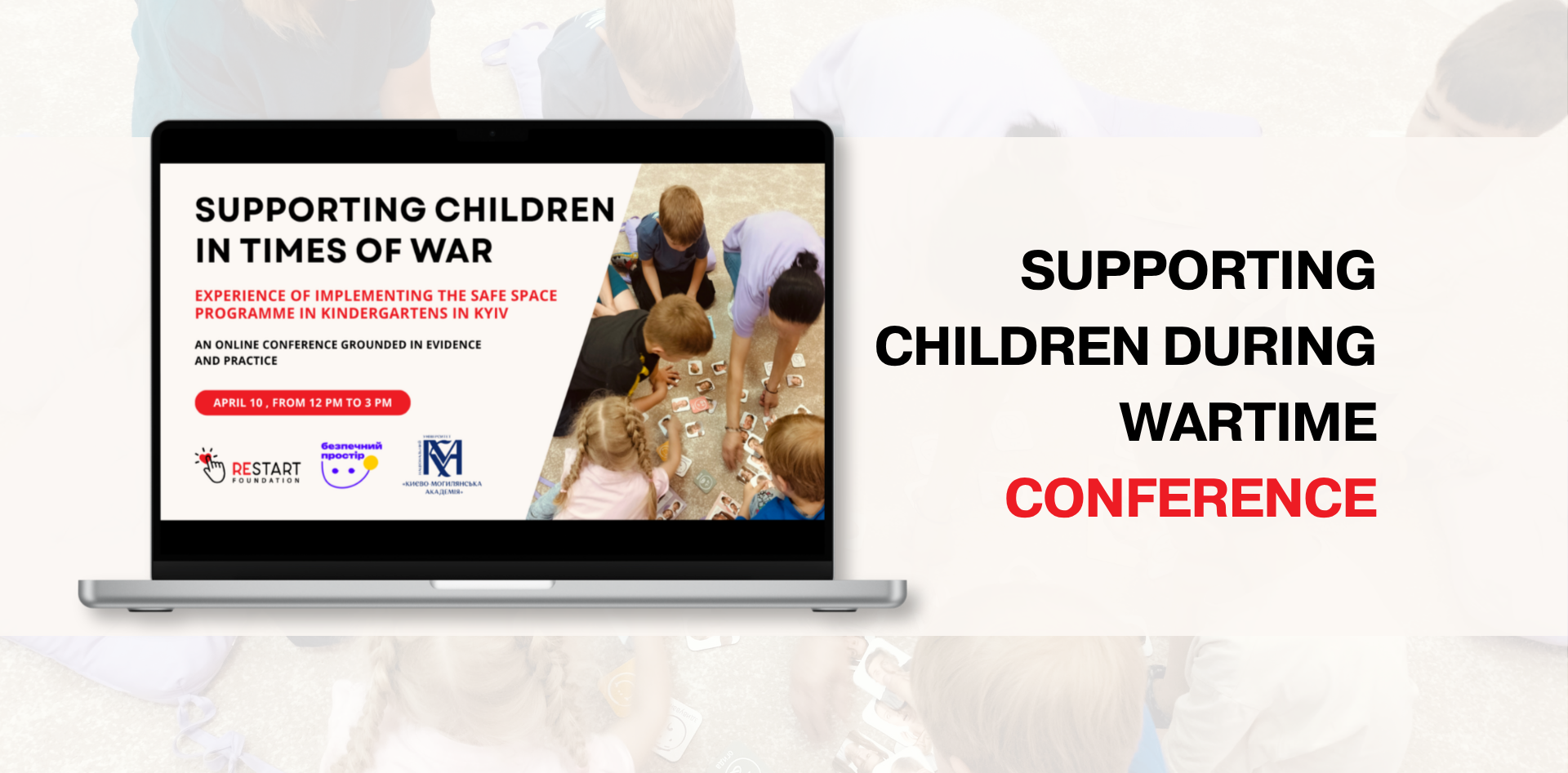
On 10 April 2026, Restart Foundation hosted an online conference bringing together educators, psychologists, and child wellbeing practitioners from across Ukraine — and beyond — to share evidence-based experience of the Safe Space programme in Kyiv kindergartens. Over three hours, nine speakers explored what it truly means to create a mentally safe environment for young children living through war.
Full conference recording — Supporting Children During Wartime, 10 April 2026
Why This Conference Matters
Children in wartime need more than shelter
Since Russia’s full-scale invasion in 2022, Ukraine’s early childhood education system has faced challenges it was never designed to handle. Educators found themselves carrying children into shelters during air raid sirens, managing extreme anxiety in children who had never previously known fear, and supporting parents who were themselves overwhelmed. Questions multiplied faster than answers.
The Safe Space programme — originally developed by the Mental Health Centre at the National University of Kyiv-Mohyla Academy (NaUKMA) — was designed precisely to address this gap: a structured, evidence-based approach to psychological support that works not just with children, but with the adults who surround them every day.
“When you see children waking up to explosions, when parents don’t know what to say to their child, when educators are literally carrying children into shelters on their backs — it becomes obvious that help is needed not eventually, but now. Systemic help. Grounded help. Not only for children, but for those who care for them.”
Alla Yansons, Founder and CEO OF Restart Foundation
people supported through the programme
children reached
parents engaged
activities delivered in one year
The Programme
Safe Space: from schools to kindergartens
The Safe Space programme has its roots in 2014, when conflict in eastern Ukraine first created a mass need for psychological recovery in educational settings. Commissioned by UNICEF and Ukraine’s Ministry of Education, National University of Kyiv-Mohyla Academy developed a group-based intervention that could work quickly, at scale, without stigma — reaching entire classrooms of children simultaneously.
What distinguished the programme from the outset was its collaborative design process. As Serhiy Bogdanov, Head of the National University of Kyiv-Mohyla Academy Mental Health Centre and co-author of the programme, explained at the conference: the team began not with theory, but with listening — conducting in-depth interviews with educators, children, and parents to understand their actual needs before designing any intervention.
Over a decade of iteration, the programme expanded from schools to early childhood settings, integrating new research on resilience factors specific to Ukrainian children: parental support, social connection, perseverance, optimism, and physical health. Longitudinal data showed results were sustained over years — children who participated continued to show stable emotional wellbeing long after the programme ended.
“Children cannot grow and flourish if the adults around them do not have the resources to support them. Supporting a child during wartime is impossible without first supporting the adults who are present with them every day.”
Oksana Zaleska, Child Psychotherapist & Author of the Safe Space for Preschoolers Programme
Conference Programme
Nine voices, one shared commitment
The conference brought together nine speakers whose presentations covered the full arc of the Safe Space programme — from its origins and theoretical foundations to its real-world implementation in kindergartens across Kyiv.
Alla Yansons
Restart Foundation: from idea to implementation — experience of collaboration with the Safe Space project in creating systemic support for children.
Founder and CEO of Restart Foundation
Serhiy Bogdanov
Development of the Safe Space programme since 2014.
Head of the Mental Health Centre, National University of Kyiv-Mohyla Academy; co-author of the Safe Space programme
Oksana Zaleska
Circles of Care — supervision as caring for adults in the Safe Space programme.
Child psychotherapist; leading expert, National University of Kyiv-Mohyla Academy Mental Health Centre; author of the Safe Space for Preschoolers programme; project supervisor
Oksana Tunyk
The impact of the Safe Space programme on children’s emotional self-regulation.
Child psychologist; emotional intelligence trainer; psychologist of the Safe Space project
Olena Tkachenko
Reaching the parents. Building parent engagement within the Safe Space programme.
Child psychologist; mentor of the Safe Space programme
Ievgeniia Zavorotynska
“I’m scared a rocket will hit our house.” Challenges of working with children during wartime.
Child psychologist; mentor of the Safe Space programme
Hanna Shvets
Integrating the principles of the Safe Space programme into team practice: a teacher’s journey from observer to active agent of change.
Head at M’Andryk International School; trainer of the Safe Space programme
Anastasiia Moroz
A place where children feel safe: experience of programme implementation.
Deputy Director for Educational Process, Happiness Kids kindergarten
Svitlana Kosachova
When children start listening to each other: how a safe space transforms the atmosphere in a group.
Educational psychologist, Happiness Kids kindergarten
Key Themes
What the conference revealed
Adults first. One of the most consistent themes across presentations was the centrality of adult wellbeing. Children cannot be emotionally regulated by adults who are themselves dysregulated. The Safe Space programme’s model of supervision — Oksana Zaleska’s “Circles of Care” — places structured support for educators and psychologists at the heart of the intervention, not as an afterthought.
The classroom as a safe container. Multiple speakers emphasised that safety for children is not primarily physical — it is relational. A group where children feel seen, heard, and accepted can function as a genuine buffer against the psychological impact of war. Svitlana Kosachova described how Safe Space practices transformed the entire atmosphere of a kindergarten group over time, with children beginning to listen to each other in ways they never had before.
Parents as partners, not recipients. Olena Tkachenko’s presentation on parent engagement challenged the traditional model of parents as passive recipients of professional advice. In the Safe Space programme, parents are actively involved as co-participants in creating a supportive environment — both at home and in partnership with the kindergarten.
Normalising fear. Ievgeniia Zavorotynska’s session — titled after a child’s direct question, “I’m scared a rocket will hit our house” — addressed the challenge of honest, age-appropriate conversations about war. Children need adults who can sit with difficult questions rather than deflecting or minimising them.
The conference in numbers
Over 300 participants registered from kindergartens, private schools, psychological practices, charitable organisations, and educational institutions across Ukraine, as well as participants from the UK. Simultaneous interpretation between Ukrainian and English was provided throughout.
Participant Response
Voices from the conference
Gerry Byrne
Founder of the Lighthouse Reflective Parenting Programme; Consultant Child & Adolescent Psychoanalytic Psychotherapist · via Zoom chat · 10 April 2026
“Many thanks to all the speakers for such a fascinating and inspiring conference. It is clear the programme helps children feel seen and heard, and profoundly impacts their experience of safety, and the continual, almost daily need for the re-establishment of safety in their relationships and internally. Keeping a playfulness in approach appears key, it is impressive how facilitators, teachers, supervisors, all support this creativity. Wonderful also to hear about the impact on teachers and parents, deepening their connection with their children. Many thanks again.”
Get Involved
Join the Safe Space community
The Safe Space programme is actively expanding to new kindergartens in Kyiv and beyond. If you are an educator, psychologist, or institution leader interested in implementing the programme, or if you would like to train as a project intern or mentor, please visit the programme page.
All conference materials — including the recording above, the ERC (Emotion Regulation Checklist) in English and Ukrainian, and additional resources — are available via the Restart Foundation website and social channels.
Interested in the Safe Space Programme?
Learn how to register your kindergarten, view the programme details, and meet the team.
